


![[ National Tax Association ]](https://ntanet.org/wp-content/themes/nta-custom/library/images/nta-whitebg-web-top.svg "National Tax Association")

As global leaders focus on short-lived climate pollutants as part of their climate mitigation strategies, methane has emerged as a critical target because it is a highly potent greenhouse gas.
Join the National Tax Association on March 10 at 1:00 PM EST for a one-hour webinar exploring the intersection of methane regulation, international trade, and tax policy. This session will feature leading experts presenting top-tier research on the technical and economic challenges of measuring and mitigating methane emissions.
- Key discussion topics include:
Methane regulations in major economies - Measurement, reporting, and verification of methane emissions
- Mitigating methane emissions in international trade via border adjustment mechanisms
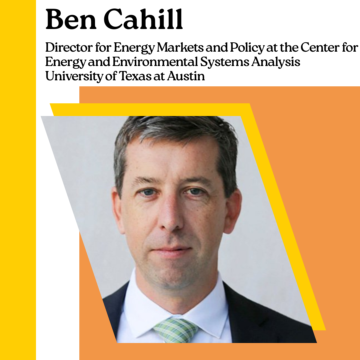 Ben Cahill is director for Energy Markets and Policy at the Center for Energy and Environmental Systems Analysis at the University of Texas at Austin. He was formerly a senior fellow in the Energy Security and Climate Change Program at the Center for Strategic and International Studies (CSIS). He covers oil markets, geopolitics, and macro trends affecting the oil and gas industry. He has led several research initiatives on methane emissions and global gas, analyzed how national oil companies are responding to the energy transition, and covered the market and geopolitical impact of U.S. LNG exports. Prior to CSIS, he was a director in Energy Intelligence’s Research & Advisory group and led its country risk practice, advising oil and gas companies on politics, economics, and policy risks. He also wrote on corporate strategy and covered Saudi Aramco, Abu Dhabi National Oil Company, and the Southeast Asian national oil companies. Ben formerly worked at PFC Energy (now part of S&P Global) in Washington, DC, and Kuala Lumpur, focusing on country risk and macro trends in the oil and gas industry. He has an MA in international affairs and economics from the Johns Hopkins School of Advanced International Studies and a BA in international relations and English from Boston University.
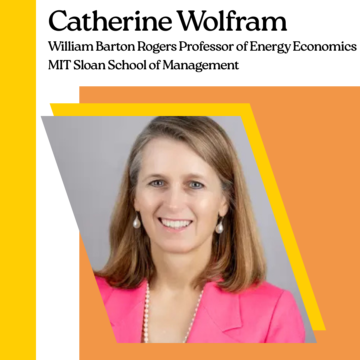
Catherine Wolfram is the William Barton Rogers Professor of Energy Economics at the MIT Sloan School of Management.
She previously served as the Cora Jane Flood Professor of Business Administration at the Haas School of Business at UC Berkeley.
From March 2021 to October 2022, she served as the Deputy Assistant Secretary for Climate and Energy Economics at the U.S. Treasury, while on leave from UC Berkeley. Since March 2025, Wolfram has served on the COP30 Ad Hoc Council of Economists and chaired a working group on climate coalitions.
Before leaving for government service, she was the Program Director of the National Bureau of Economic Research‘s Environment and Energy Economics Program and a Research Affiliate at the Energy Institute at Haas. Before joining the faculty at UC Berkeley, she was an Assistant Professor of Economics at Harvard.
Wolfram has published extensively on the economics of energy markets. Her work has analyzed rural electrification programs in the developing world, energy efficiency programs in the US, the effects of environmental regulation on energy markets and the impact of privatization and market restructuring in the US and UK. She is currently working on projects at the intersection of climate, energy, and trade, including work on carbon border adjustment mechanisms and oil market sanctions.
She received a PhD in economics from MIT in 1996 and an AB from Harvard in 1989.
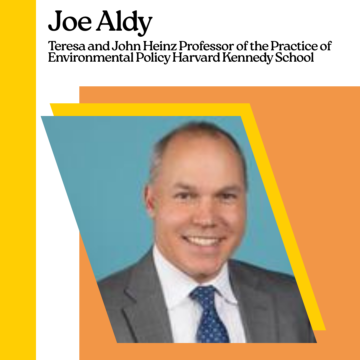
Joe Aldy is the Teresa and John Heinz Professor of the Practice of Environmental Policy at the Harvard Kennedy School. His research focuses on climate change policy, energy policy, and regulatory policy. He is a currently a University Fellow at Resources for the Future, a Faculty Research Fellow at the National Bureau of Economic Research, and a Senior Adviser at the Center for Strategic and International Studies. He is also the Faculty Chair for the Regulatory Policy Program at the Mossavar-Rahmani Center for Business and Government.
In 2009-2010, Aldy served as the Special Assistant to the President for Energy and Environment, reporting through both the National Economic Council and the Office of Energy and Climate Change at the White House. Aldy was a Fellow at Resources for the Future from 2005 to 2008 and served on the staff of the President’s Council of Economic Advisers from 1997 to 2000. He also served as the Co-Director of the Harvard Project on International Climate Agreements, Co-Director of the International Energy Workshop, and Treasurer for the Association of Environmental and Resource Economists before joining the Obama Administration.
He holds a PhD in economics from Harvard University, a Master of Environmental Management degree from the Nicholas School of the Environment, and a BA from Duke University.
Moderator
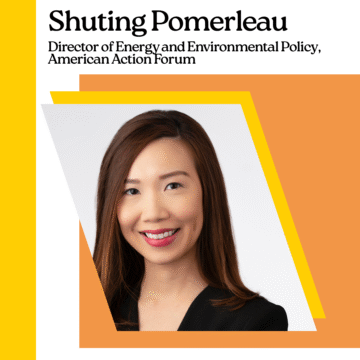
Shuting Pomerleau is the Director of Energy and Environmental Policy at the American Action Forum.
Shuting’s work focuses on energy and environmental policy analysis. Research topics include carbon border adjustments, carbon taxation, climate and trade, the latest developments in energy markets, and electricity markets. Her work has been featured in a wide range of outlets including Bloomberg, Financial Times, and TIME. She has also spoken at many public conferences and events.
Prior to joining AAF, Shuting served as the Deputy Director of Climate Policy at the Niskanen Center working on market-based climate change mitigation policies. Previously, she was a business strategy consultant working with senior executives of multinational corporations to advise their business strategies for U.S. and international markets.
Shuting holds a master’s degree in public policy from Georgetown University.
![[ NTA ]](https://ntanet.org/wp-content/themes/nta-custom/library/images/nta-white-logo.svg "National Tax Association")


