


![[ National Tax Association ]](https://ntanet.org/wp-content/themes/nta-custom/library/images/nta-whitebg-web-top.svg "National Tax Association")
The Equity & Inclusion Travel Fellowship provides conference travel funding with the goal of increasing participation in and creating long-lasting relationships with the National Tax Association and its activities among underrepresented minority (URM) graduate students and early career Ph.D.s/J.D.s engaged in the theory and practice of public finance, including public taxation, spending, and borrowing. The Fellowships will cover hotel, conference registration, and a travel cost offset.
Underrepresented minority scholars face a variety of systemic barriers and may lack peers, role models, or mentors in their own departments and networks. Professional conferences, like the NTA, are a helpful place to build relationships outside of one’s own academic and professional settings. The aim of this fellowship is to provide an opportunity for junior scholars to participate in and network with the NTA community.
All Ph.D. or J.D. advanced graduate students (4th year or later for Ph.D. candidates, 2nd or 3rd year for law students) or early career graduates (fewer than 6 years since graduate degree) with interests in the theory and practice of public finance, who are members of an underrepresented minority group. Underrepresented minorities include persons who identify as American Indian, Alaskan Native, Black (not of Hispanic origin), Hispanic (including persons of Mexican, Puerto Rican, Cuban, and Central or South American origin) or, Pacific Islander. Eligible fellowship recipients will also be a U.S. Citizen, Permanent Legal Resident, DACA or Eligible Non-Citizen (as defined by FAFSA).
The travel fellowship is inspired by the successful American Economic Association URM Travel Grants and the Association for Public Policy Analysis and Management Equity and Inclusion Fellowships.
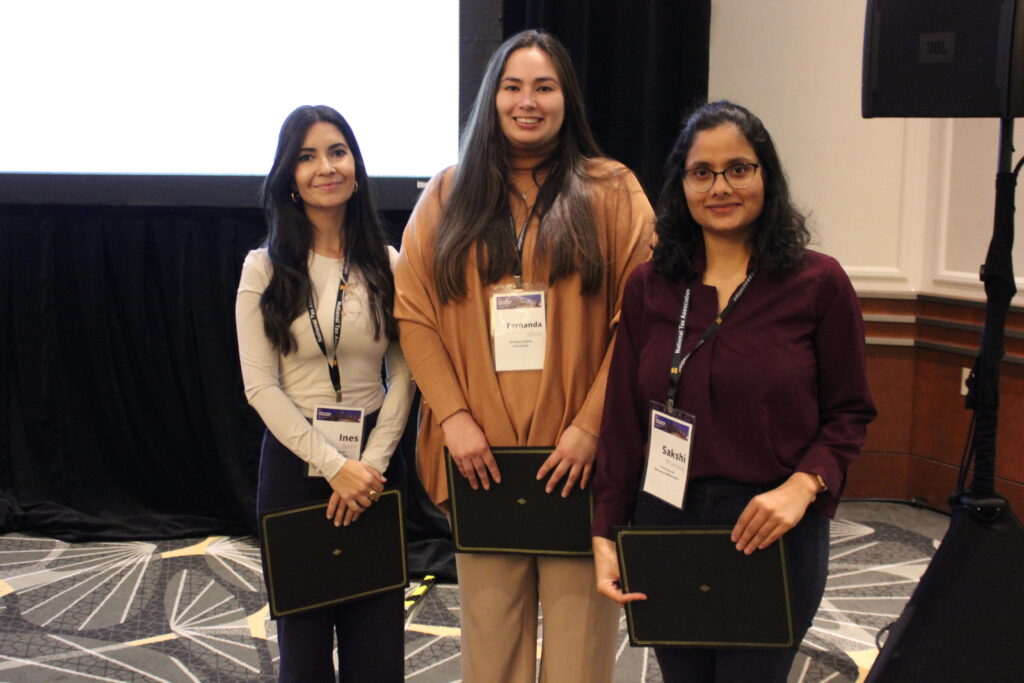
2025 NTA Equity and Inclusion Travel Fellows: Maria Ines Badin; Fernanda Alfaro-Gonzalez; Sakshi Bhardwaj
2025 Recipients
 Fernanda Alfaro-Gonzalez is a PhD Candidate in Agricultural, Food, and Resource Economics at Michigan State University. Her research centers on public finance, taxation, and regional development. She has collaborated with organizations such as the Inter-American Development Bank and the Organisation for Economic Co-operation and Development, and the Lincoln Institute of Land Policy. Her work has appeared in leading journals such as the National Tax Journal and the Journal of Regional Science. Her dissertation, Essays on Price Adjustment and Spatial Equilibrium in the United States, investigates the spatial dynamics of prices and their implications for regional economies.

Maria Ines Badin is a PhD candidate in Economics at the University of California, Davis, specializing in public economics and development. Her research examines how governments can optimally deliver social protection to vulnerable populations, particularly in developing settings characterized by capacity constraints and limited income verifiability. A complementary line of work studies how politicians’ preferences, beliefs, and networks shape policy priorities and the implementation of tax policies. She holds an MS in Applied Economics from Johns Hopkins University and a BA in Economics from the University of Tucuman. Before her PhD, she worked at the World Bank and the Inter-American Development Bank
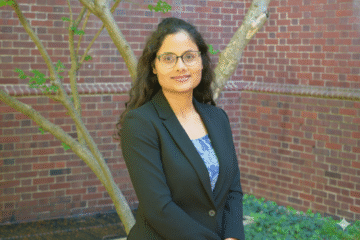 Sakshi Bhardwaj is an Assistant Professor of Economics at the University of Wisconsin-Whitewater. She completed her Ph.D. in Economics from the University of Illinois at Urbana-Champaign in 2024. She is an applied microeconomist with research interests in public economics and labor economics. Her research focuses on understanding the impact of programs that support low-income families and improve economic opportunities for underprivileged individuals.
 Tejendra P. Singh is a fifth-year Ph.D. candidate at Georgia State University. Almost all of his work utilizes novel data sources, such as text and satellite imagery data, to generate insights of direct policy relevance. He has two research agendas. His first research agenda is at the intersection of labor and environmental economics. The constant theme in these works is the use of natural experiments generated by environmental shocks to examine their effect on outcomes such as defaults on legal financial obligations arising out of low-level traffic violations, leading to defendants getting entangled in the wider US criminal justice system, the effects of which are not equally distributed and are highly costly both economically and socially. Other works in this research agenda have examined, for instance, how people allocate their time between indoor and outdoor activities on very polluted days. His second research agenda in health economics has a consistent theme regarding the role of spatial access to healthcare facilities in driving outcomes.
Previous Fellows
2024 NTA Equity & Inclusion Travel Fellowship
2023 NTA Equity & Inclusion Travel Fellowship
2022 NTA Equity & Inclusion Travel Fellowship
2021 NTA Equity & Inclusion Travel Fellowship
![[ NTA ]](https://ntanet.org/wp-content/themes/nta-custom/library/images/nta-white-logo.svg "National Tax Association")


