


![[ National Tax Association ]](https://ntanet.org/wp-content/themes/nta-custom/library/images/nta-whitebg-web-top.svg "National Tax Association")
The One Big Beautiful Bill Act, enacted on July 4, 2025, brought significant changes to both business and individual taxation. To mark the first anniversary of this landmark legislation, the National Tax Association, with sponsorship from the Peter G. Peterson Foundation, has convened a panel of experts to examine the bill’s passage, implementation, and effects to date. The webinar will explore what has worked well, where challenges have emerged, and how different groups have been affected. Panelists will also discuss the bill’s potential short- and long-term implications for taxpayers, businesses, and the broader economy.
Speakers:
Michael Faulkender, William A. Longbrake Professor, University of Maryland
John Iselin, Associate Director of Economic Analysis, The Yale Budget Project
Richard Johnson, Vice President Financial Security, AARP Public Policy Institute
Elena Patel, Co-Director, Urban-Brookings Tax Policy Center
Moderator:
Cathy Koch, Vice President Tax Policy, The Peter G. Peterson Foundation
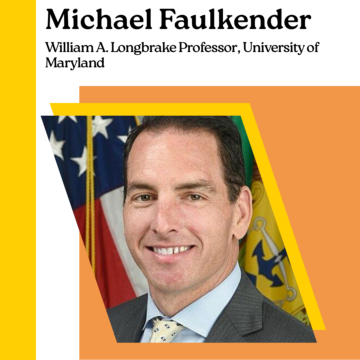
Michael Faulkender is the William A. Longbrake Professor of Finance at the Smith School. He joined the University of Maryland in 2008 and was the Associate Dean of Master’s Programs in 2017 and 2018. On March 26, 2025, he was confirmed by the U.S. Senate as the 16th Deputy Secretary of the Treasury. Further, on April 21, 2025, he was appointed acting commissioner of the Internal Revenue Service.
Previously, in 2019, Faulkender served as the Assistant Secretary for Economic Policy at the US Department of Treasury. In that role, he advised the Secretary on domestic and international issues that impacted the economy. During the COVID-19 pandemic, he assisted in negotiating the CARES Act and was the senior Treasury official who led the implementation of the Paycheck Protection Program (PPP). In January, he was awarded the Alexander Hamilton Award for Distinguished Leadership, the highest service award granted at the Department of the Treasury.
His research lies at the intersection of financial economics and public policy. Examples include the job impacts of the PPP, corporate capital structure, risk management, corporate liquidity, and executive compensation. His work has been published in top academic finance journals, received numerous “best paper” awards, and has been cited in the Wall Street Journal, Washington Post, and The New York Times, among others.
 John Iselin is an Associate Director of Economic Analysis at the Budget Lab. He is an applied public and labor economist, whose work focuses on topics of taxation and fiscal policy. He conducted research on topics including state tax credits, the migration responses of older adults to tax changes, high-income tax evasion, and the cyclicality of the social safety net.
Prior to starting at the Budget Lab, he worked for the Congressional Budget Office as an associate analyst, as a staff economist at the White House Council of Economic Advisers, as a research fellow at the California Policy Lab, and as a research assistant at the Urban-Brookings Tax Policy Center. He holds a B.A. in economics from Reed College, an MPP from U.C. Berkeley, and a Ph.D. in economics from the University of Maryland.
 Richard Johnson, Ph.D., is vice president of financial security at the AARP Public Policy Institute. He leads a team of experts on Social Security and other income support programs, retirement savings, employer retirement plans, older workers, financial fraud, and financial well-being.
Before joining AARP, Johnson was a senior fellow and practice area lead for aging and retirement at the Urban Institute, where he worked to advance the understanding of how current government policies, private sector practices, and demographic trends influence older Americans’ economic security and decision making.
Johnson’s research focuses on financial security at older ages. He has authored or co-authored more than 250 journal articles, book chapters, and research reports and testified before Congress and federal commissions. His work has been published in leading academic journals, such as the Journal of Labor Economics, Journal of Human Resources, and Health Affairs, and featured in national media outlets, including The New York Times, Wall Street Journal, and NPR. Johnson holds a doctorate in economics from the University of Pennsylvania and a bachelor’s degree in economics from Princeton University.

Elena Patel is a senior fellow at the Brookings Institution and co-director of the Urban-Brookings Tax Policy Center. Her research examines how tax systems, health programs, social programs, and governance structures shape economic behavior and well-being. She has studied the design of optimal tax systems and their effects on investment and capital accumulation, how workers respond to changing incentives and risks, how leadership and governance affect firms, and how health policies spill over into labor markets. Before joining Brookings, she was an assistant professor at the University of Utah’s David Eccles School of Business, a senior public finance economist at the Council of Economic Advisers, and also held positions at the U.S. Treasury Department, the Postal Regulatory Commission, the Congressional Budget Office, and the U.S. Department of Justice. She earned her Ph.D. in economics from the University of Michigan.
Moderator

Cathy Koch joined The Peterson Foundation as Vice President, Tax Policy In September 2024. Prior to Peterson, Cathy spent more than 12 years at EY, where she served as Americas Tax Policy Leader and Global Sustainability Tax Leader, a practice she founded.
Cathy also has extensive public sector experience. She served as Chief Policy Advisor for Tax and Economics to Senate Majority Leader Harry Reid. She also led business outreach for the Leader and the Democratic Caucus. Cathy’s prior experience on the Hill included working on the Finance Committee, first as Staff Director for the Finance Subcommittee on Energy, Natural Resources and Infrastructure, and then as the Tax Chief of the full committee. During her tenure at Senate Finance, Cathy led the tax team on critical legislation including the 2008 financial rescue, the 2009 American Recovery and Reinvestment Act, and the Affordable Care Act.
In addition to her experience on Capitol Hill, Cathy recently served as Special Advisor at the Department of Energy. Her private sector experience also includes serving as Director of U.S. Tax Policy for General Electric and Director of Global Government Affairs at Amgen, Inc.
Cathy started her tax career as an economist at the Joint Committee on Taxation. She spent 4 years at the Joint Committee after an internship she started while doing her Ph.D. in economics at Georgetown University. Cathy also taught at Georgetown’s Public Policy School and is currently on the Board of Advisors.
![[ NTA ]](https://ntanet.org/wp-content/themes/nta-custom/library/images/nta-white-logo.svg "National Tax Association")


